Every document, one library, on your rack.
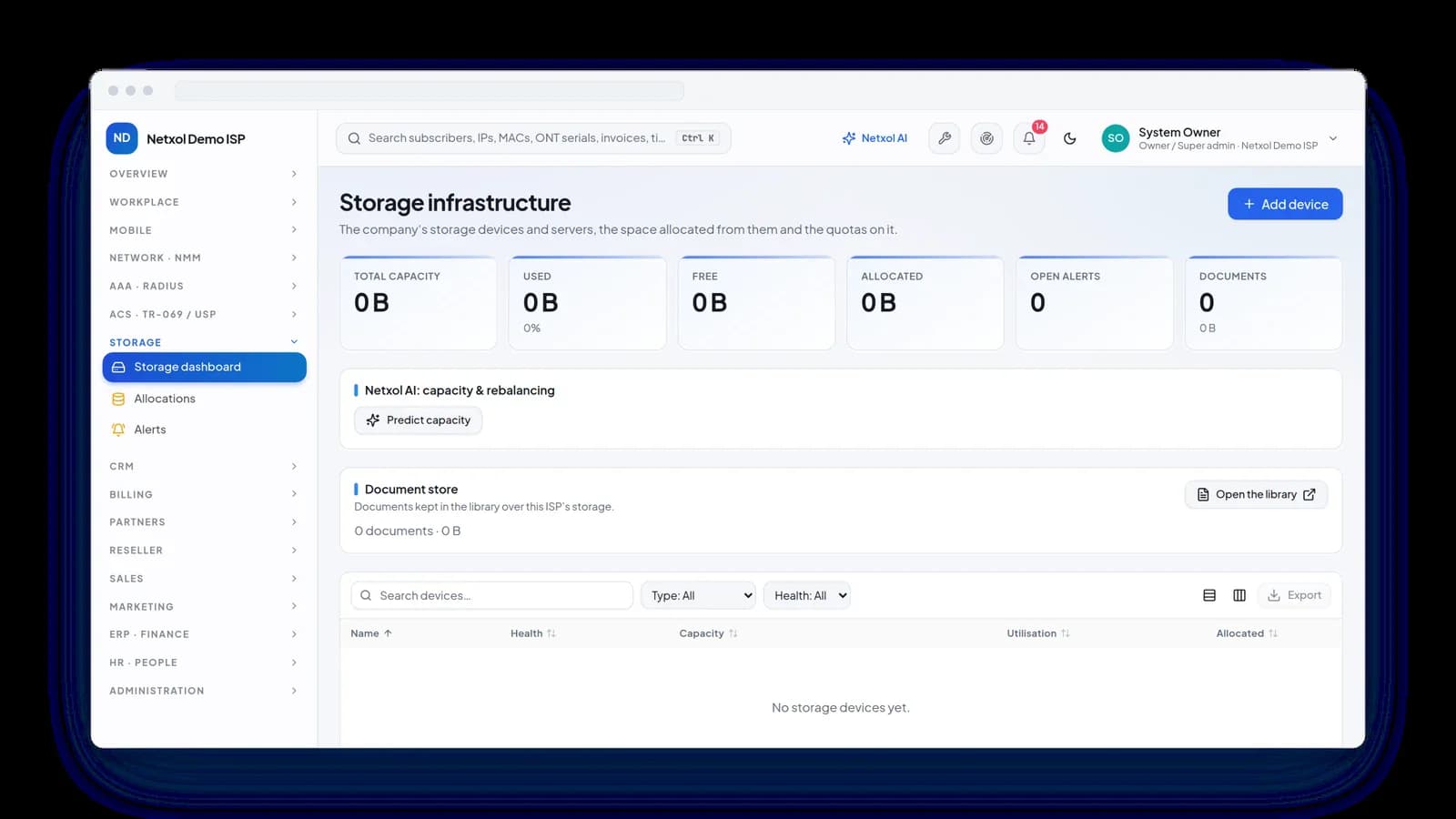
One document library over the whole operator — folders, versions, retention, legal hold, templates to PDF, e-sign and full-text search — stored where you rack the Core and backed up to your own object store. Nothing leaves your network unless you choose.
- Versions · retention · legal hold
- Templates to PDF · e-sign
- On-premise · your own backups
Which version did the customer actually sign?
In most operators, contracts, KYC documents and signed work orders are scattered across inboxes and shared drives. Nobody can prove which version was signed, retention and legal-hold obligations live in someone’s head, and the documents sit in a cloud the operator doesn’t control.
- Contracts, KYC documents and signed work orders are scattered across inboxes and shared drives
- Nobody can prove which version of a contract a customer actually signed
- Retention and legal-hold obligations are tracked in someone’s head
- Documents sit in a third-party cloud the operator doesn’t control
One library, versioned, retained and owned.
Because the library sits over one documents table linked to every record, a contract, a KYC file and a proof of delivery are one search away — and governed by rules the database enforces.
One library over everything
A single document library over one documents table — folders and per-entity folders — so a customer’s contract, a partner’s KYC and a field job’s proof of delivery all live in one place, linked to the record they belong to.
Versions & audit
Every document is versioned with a full history and audit trail, so you always know which version was sent, signed or superseded — and who did it.
Retention & legal hold
Retention schedules and legal hold are enforced in the database: every delete asks whether the document is held, so an obligation is a rule, not a reminder.
Templates & e-sign
Generate documents from templates to PDF and sign them through the contracts module — quotes, contracts and agreements signed and filed without leaving the platform.
Full-text search
Find any document across the operator by its content, not just its name, scoped to what the user’s role is allowed to see.
On your rack, your backups
Storage lives where you rack the Core. Nothing leaves your network unless you choose to replicate it, with encrypted backups to your own S3-compatible object store.
What runs under storage.
Library
Folders, versions, retention, legal hold and full-text search.
Contracts
Templates to PDF and e-sign for quotes, contracts and agreements.
Security & audit
Role-scoped access, encryption at rest and a single audit trail.
Backups & storage
On-premise storage with backups to your own object store.
What compliance and IT ask.
Does Netxol One include document storage?
Yes. Netxol One has one document library over a single documents table — folders and per-entity folders, versions, retention, legal hold, templates to PDF, e-sign and full-text search — so every operator document lives in one place, linked to the record it belongs to.
How are retention and legal hold enforced?
In the database. Retention schedules apply automatically and every delete checks whether a document is under legal hold, so obligations are enforced as rules rather than tracked by hand.
Where is my data stored?
On the rack where you run the Core. Documents never leave your network unless you choose to replicate them, and backups go to your own S3-compatible object storage, encrypted with your keys.
Can I sign documents in the platform?
Yes. Generate from templates to PDF and sign through the contracts module — quotes, contracts and partner agreements are signed and filed without a separate e-sign service.
Can Netxol AI use the documents?
Yes, within the role’s permissions. Netxol AI can find and reference documents a user is allowed to see, grounded in the operator’s own library.
The document, the version and the signature. Owned.
Netxol One gives telcos and ISPs one governed document library and storage layer over the whole operator — on your rack, with your backups, and Netxol AI reading only what a role allows.