
From the OLT to the ONT to the CPE. Discovered, monitored and managed on one console.
NMM is the network side of NOS: a living inventory of every managed element, a topology that stays true, and — critically — the tools to act on it. Multi-vendor OLT management, TR-069/TR-369 ACS with zero-touch CPE provisioning, RADIUS/PPPoE + DHCP proxy, central syslog and every mainstream monitoring pipe: SNMP, gNMI, NetFlow. Built for ISPs at every scale.
- Auto-discovery + live L2/L3 topology
- Multi-vendor OLT / GPON / XGS-PON
- TR-069 · TR-369 ACS · Zero-touch CPE
- RADIUS · Syslog · DHCP proxy · GIS

Why Netxol NMM.
Every benefit below traces back to a specific capability in the platform — not a marketing slogan. See the capability grid at the bottom of the page for the full register.
One console, every layer — from the OLT to the CPE.
NMM discovers, monitors and manages every device that carries traffic for a subscriber. OLT cards + PON ports, ONT/ONU optical power, subscriber CPE via TR-069/TR-369, upstream routers and switches — all under one topology, one alarm feed and one change-audit log. No more juggling four vendor UIs.
Zero-touch CPE provisioning that actually eliminates the truck roll.
A device shipped to a subscriber phones home to the built-in ACS, authenticates, downloads its template by service profile and comes up configured — in seconds. TR-069 for legacy, TR-369 (USP) for modern. Firmware repo, device templates and vendor-extension handling included.
One collector for every protocol the industry uses.
SNMP v2c/v3, ICMP, syslog, NetFlow / sFlow / IPFIX, streaming telemetry (gNMI/gRPC), RADIUS accounting, DHCP lease events and modern APIs — all normalised into the same graph. New vendor? Add an adapter. NMM speaks the language.
Fault before subscribers report it. Recovery before they complain.
Synthetic probes simulate the subscriber experience from your edge. Optical thresholds catch a dying splice weeks in advance. Root cause is correlated across topology and time. And the AI Engine can — under your policy — close the loop with the same tools an engineer would use.
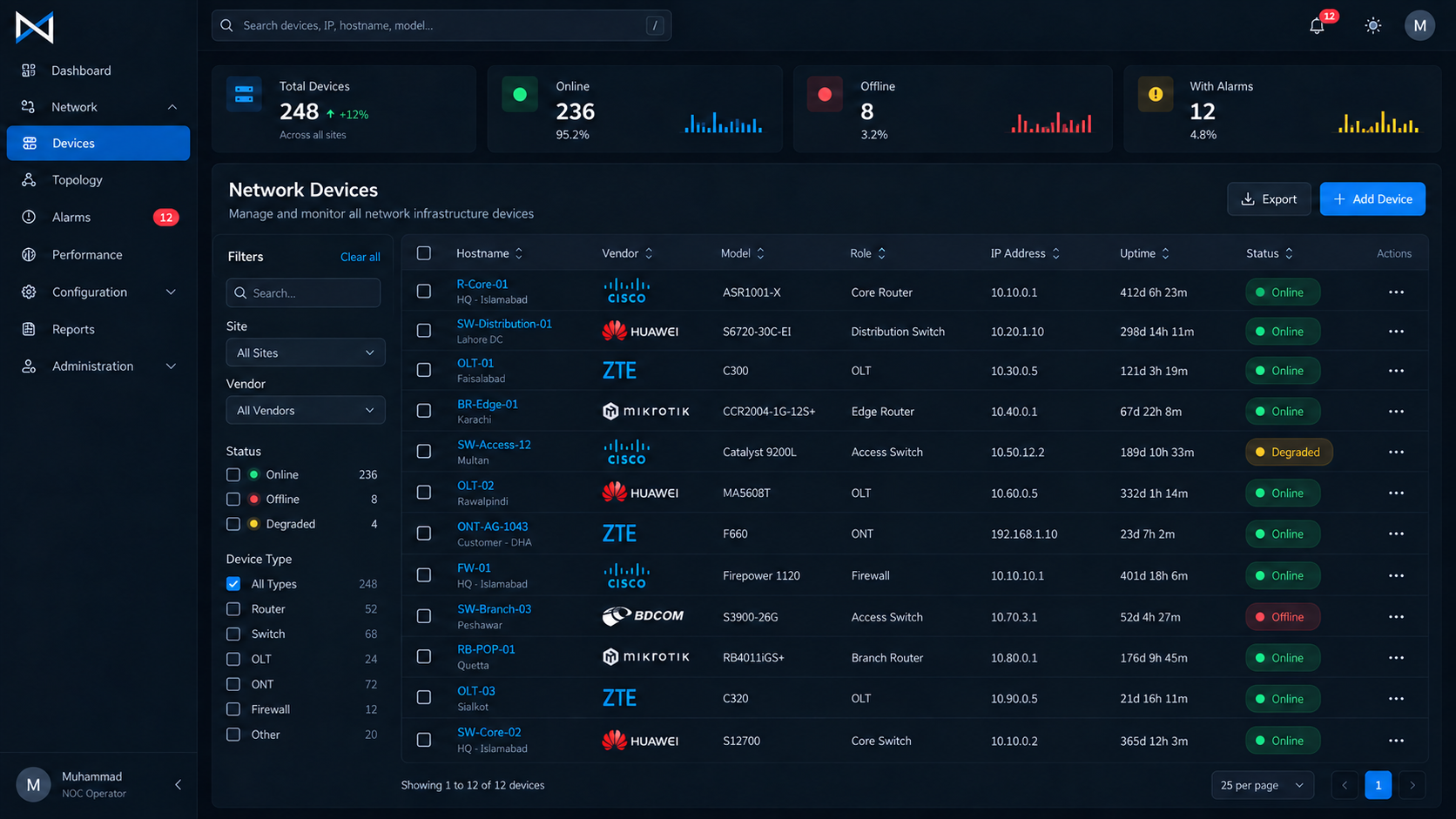
A living register of every device — plus the map that draws itself.
NMM continuously discovers, identifies and classifies every device on your network. L2 (LLDP/CDP/LACP) and L3 (OSPF/BGP) neighbours are learned from the devices themselves, so the topology is always ground truth. Attributes, credentials, monitoring templates, thresholds and polling policy are applied automatically the moment identification is confident.
- Range + seed discovery, scheduled or on-demand
- Vendor / model / role identification with confidence scoring
- Auto-learned L2 / L3 topology + GIS overlay
- Blast-radius visualisation on any failure
- Automatic template + threshold application
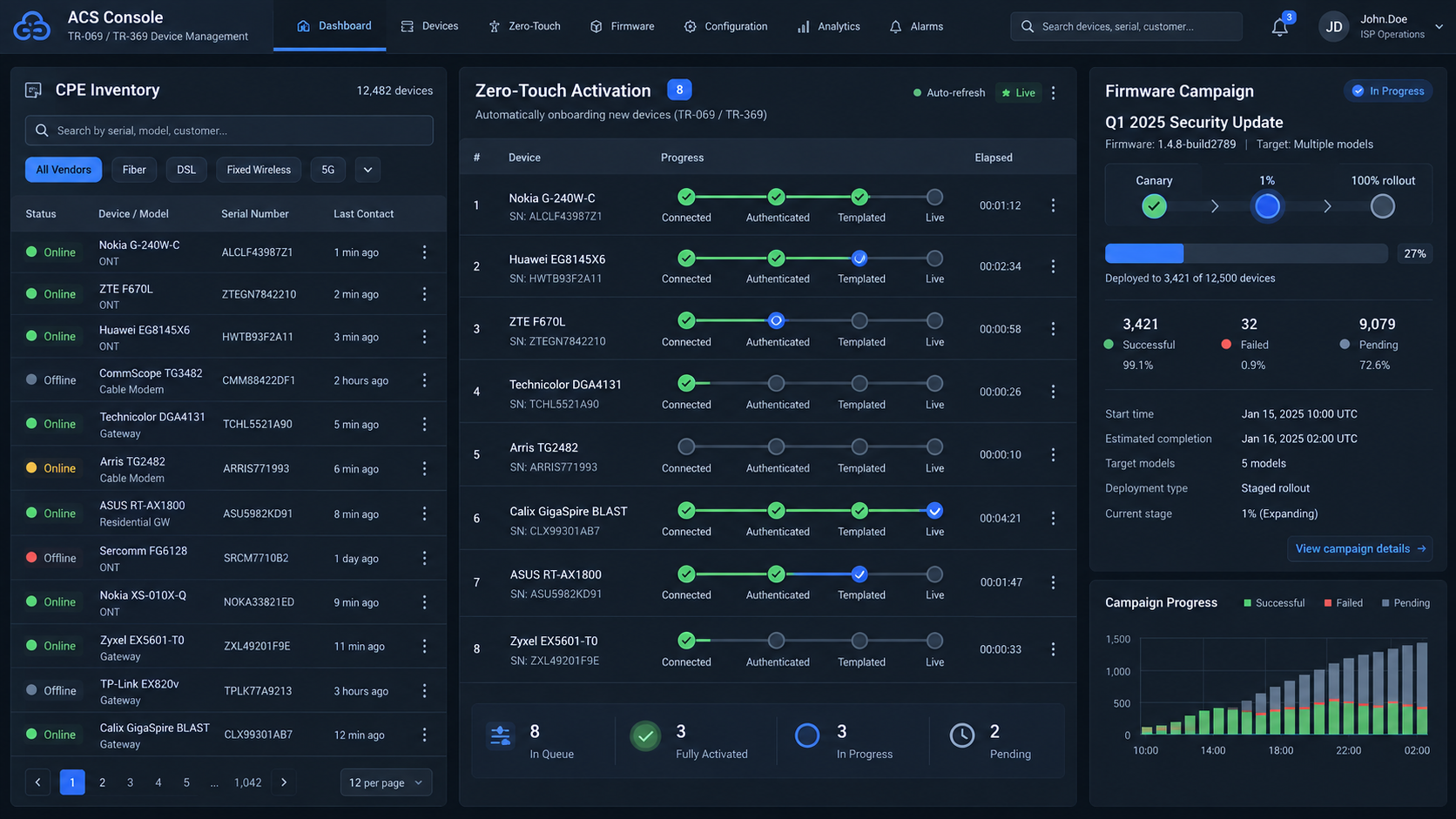
Built-in TR-069 and TR-369 ACS — with zero-touch CPE activation.
The ACS is a first-class part of NMM, not a bolted-on tool. TR-069 (CWMP) and TR-369 (USP) live on the same graph as the subscriber, the service and the OLT port — so a CPE change and a plan change are the same conversation. Zero-touch activation eliminates the truck roll for standard installs; firmware campaigns roll canary → 1% → 100% with automatic rollback on failure.
- TR-069 (CWMP) and TR-369 (USP) built-in
- MQTT / WebSocket transports for real-time USP
- Zero-touch onboarding + auto-provisioning by service profile
- Firmware repository with staged rollout + rollback
- TR-181 device model + vendor-extension handling
- TR-143 speed / latency test from the subscriber's own CPE
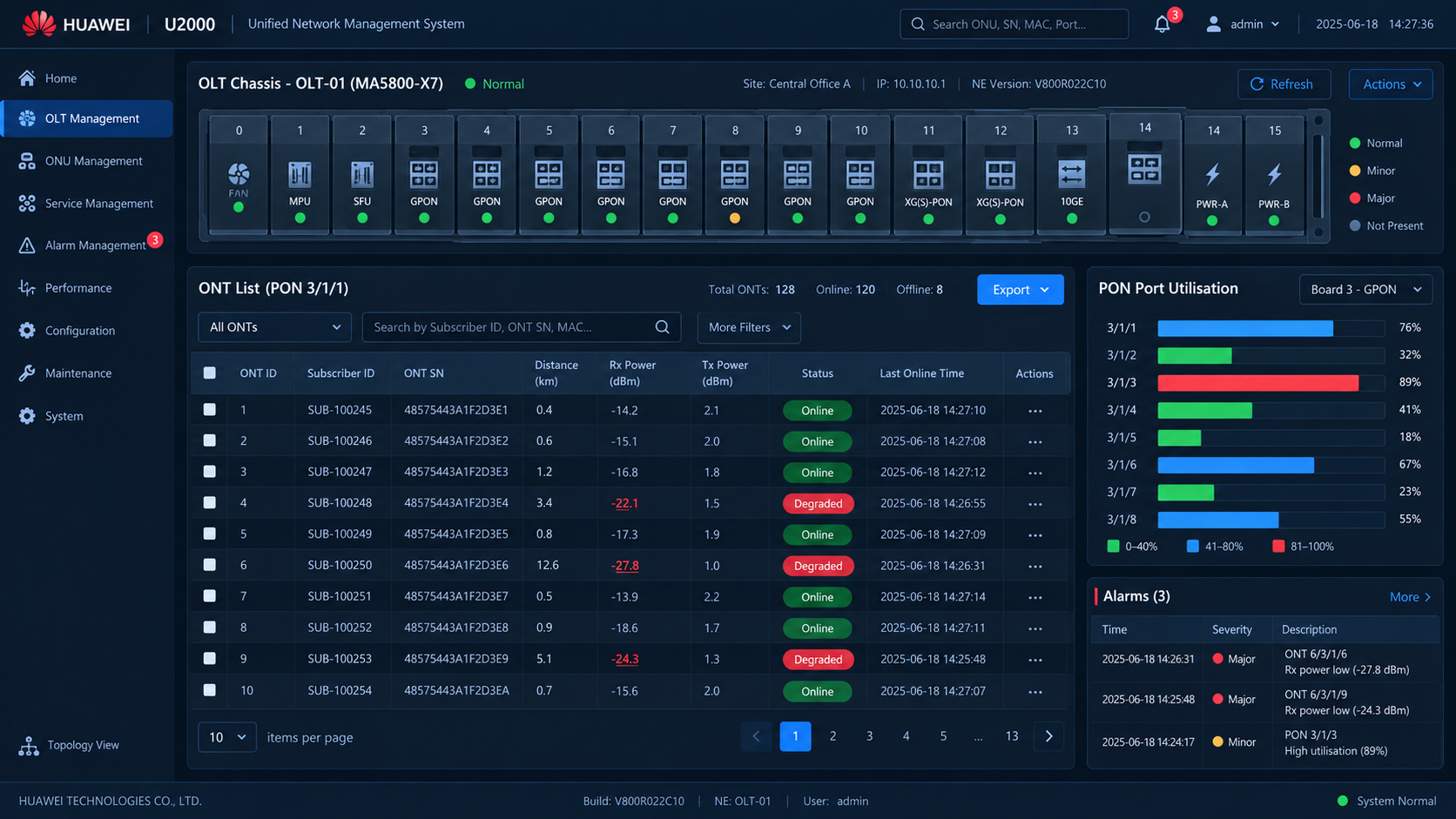
Multi-vendor OLT + PON management — the fibre operator's core screen.
Huawei, ZTE, FiberHome, CDATA, V-SOL, HSGQ, BDCOM, Nokia and more — behind one consistent, vendor-neutral interface. Cards, ports, environment and utilisation are monitored continuously. ONT/ONU are discovered automatically (including unauthorised ones), provisioned in seconds, and reclaimed cleanly on disconnect. Optical power thresholds catch a degrading splice weeks before the subscriber does.
- Vendor-neutral OLT abstraction for every major manufacturer
- ONT discovery + one-click provisioning + clean reclaim
- Optical Tx/Rx power monitoring with threshold alarms
- GPON + XG-PON + XGS-PON + EPON support
- OLT configuration management with validation + audit
- PON port utilisation + capacity planning
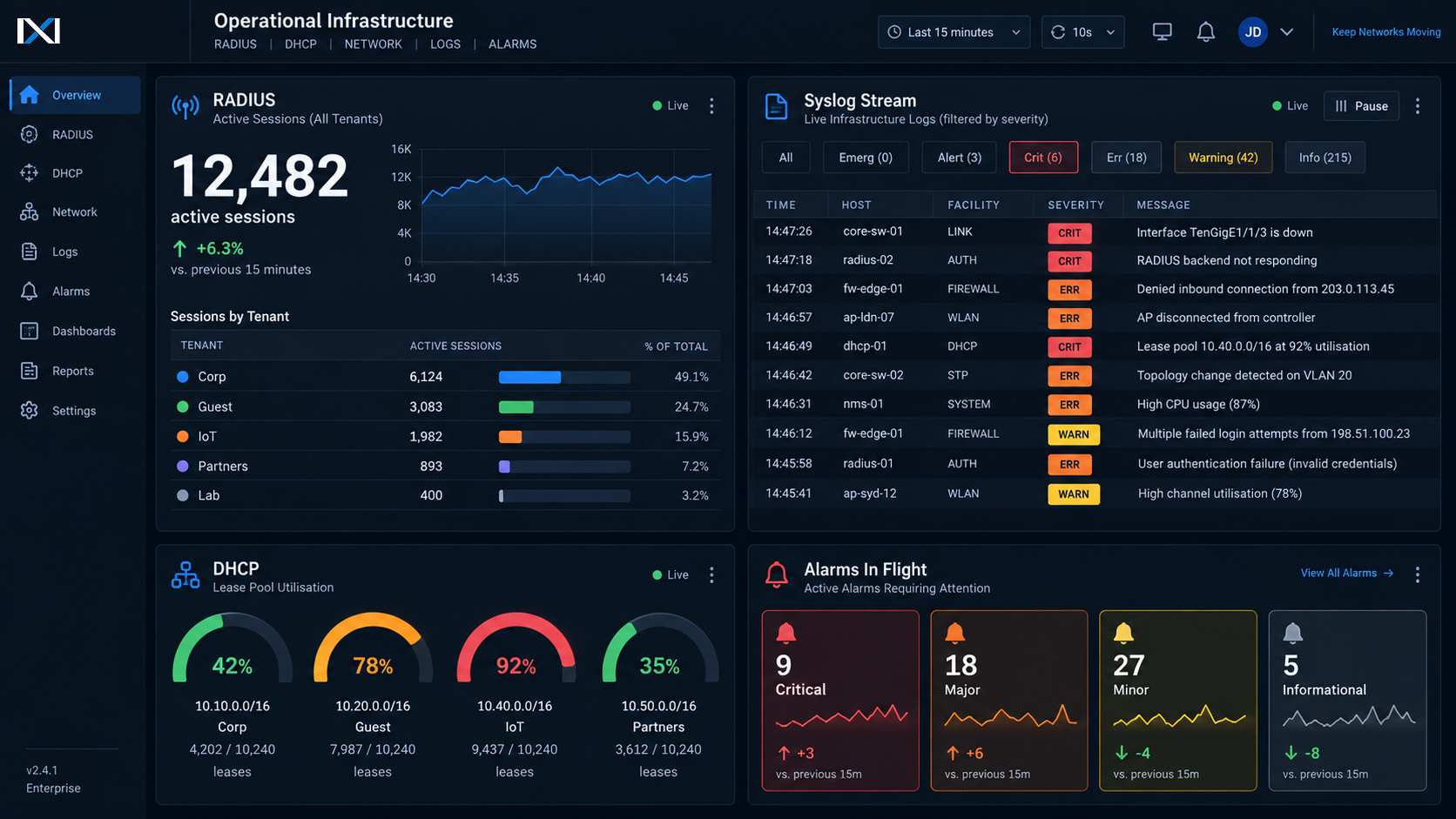
The operational infrastructure every ISP takes for granted — bundled.
NMM ships the operational infra pieces most ISPs cobble together from open source: an in-house RADIUS server for PPPoE and IPoE, a central syslog server with structured search, DHCP snooping and Option 82 relay, an outbound-address proxy layer for anti-abuse, and a GIS layer that puts poles, splice boxes and drops on the same map as the network. Everything writes to the same graph, so an alarm on an OLT card, a RADIUS accounting stop, an outside-plant splice-loss threshold and a customer ticket are the same story.
- RADIUS server (PPPoE + IPoE with DHCP Option 82)
- Central syslog server with structured, searchable retention
- DHCP relay / proxy with lease lifecycle tracking
- Outbound proxy layer for anti-abuse and lawful compliance
- GIS + fibre-plant map (poles, splices, drops, ducts, cabinets)
- Alarm correlation + RCA + closed-loop remediation via AI Engine
- SLA dashboards per neighbourhood, POP and enterprise customer
One hundred and thirty-plus capabilities. In one module. Under one licence.
Every capability below is either shipping today or landing with NOS 0.1.x. Grouped by function so an evaluator can find what they need in seconds — from OLT / PON to the ACS, from RADIUS and syslog to closed-loop AI remediation.
Range + seed discovery
Sweep a subnet or start from a device. Everything is found.
Auto identification
Vendor, model and role determined without human choice.
L2 + L3 topology
Learned from LLDP/CDP and routing protocols.
Living inventory
Continuously updated register with full history.
Grouping + tagging
Logical groups by site, role, campaign or customer.
Impact / blast radius
See downstream subscribers on any failure.
SNMP v2c/v3
The universal baseline of network monitoring.
ICMP reachability
Continuous availability and RTT measurement.
Streaming telemetry
gNMI subscribe / gRPC for carrier volumes.
Flow collection
NetFlow v5/v9, sFlow, IPFIX under one pipe.
API-based monitoring
Modern devices without SNMP still get read.
Synthetic probes
Active checks that mimic a subscriber experience.
TR-069 (CWMP) ACS
The industry-standard CPE control protocol, built-in.
TR-369 (USP) controller
Modern event-driven successor to TR-069.
MQTT / WebSocket transports
Persistent low-overhead links for real-time USP.
TR-181 device model
Manage many vendors' devices behind one interface.
Zero-touch CPE activation
Ship the device. First-connection auto-configures.
Device templates + inheritance
Thousands of devices, a handful of decisions.
Firmware repository
Approved images per model. Staged rollout + rollback.
TR-143 speed / latency test
Objective evidence from the subscriber's own CPE.
Multi-vendor OLT
Huawei, ZTE, FiberHome, CDATA, V-SOL, BDCOM, Nokia and more.
ONT / ONU management
Discovery, provisioning, deactivation, reclaim.
Optical power monitoring
Tx/Rx dBm per unit — catches a dying splice weeks early.
PON port utilisation
Load + health per port — shows next congestion point.
GPON / XG-PON / XGS-PON / EPON
Every fibre access technology in the target markets.
OLT configuration mgmt
Change from the platform with validation + audit.
RADIUS server
PPPoE, IPoE, EAP-TLS — built-in AAA.
PPPoE session mgmt
Explicit authentication + accounting from day one.
DHCP Option 82 identification
Circuit-id + remote-id map port → subscriber.
DHCP relay / proxy
Snooping, Option 82 insertion, lease lifecycle tracking.
Central syslog server
Structured, searchable, per-tenant retention.
Outbound proxy
Anti-abuse and lawful-compliance address translation.
Time-series metrics store
Per-tenant retention with roll-ups and export.
GIS + fibre-plant map
Poles, splice boxes, cabinets and drops on the same map as the network.
Route + splice management
Fibre routes, splice loss and drop counts as first-class objects.
Duct + OSP records
Duct paths, chambers and outside-plant assets tracked with the topology.
Serviceability by address
GIS-aware "can this address get fibre" answered instantly from CRM.
Field-team GIS routing
Turn-by-turn nav that already knows your poles + drops (Field App).
Alarm correlation
Deduplicate and group by topology and time.
Root-cause analysis
Which underlying failure explains the symptoms.
Incident precedent
"We have seen this before. Here is what fixed it."
Customer impact analysis
Any incident shows which subscribers are affected.
Auto-remediation
Under policy — via the bundled AI Engine.
Role-scoped consoles
NOC, engineering, care — each sees their slice.
Questions we get on the first call.
Does NMM include the ACS, or do we need a separate TR-069 server?
The ACS is part of NMM. TR-069 (CWMP) and TR-369 (USP) live on the same graph as the OLT, the subscriber and the service, so a CPE change and a subscriber-plan change are the same conversation. You do not need a separate GenieACS, Incognito or vendor ACS alongside — the platform is that server.
Which OLT / ONT vendors are supported today?
Vendor-neutral OLT and ONT abstraction ships for Huawei, ZTE, FiberHome, CDATA, V-SOL, HSGQ, BDCOM, Nokia and more. Adding a new vendor is a plugin adapter — the platform does not require a new release, and existing operators keep their hardware investment.
Do we still need FreeRADIUS, a separate syslog server, GenieACS and a DHCP relay if we adopt NMM?
No. NMM bundles a production RADIUS server (PPPoE + IPoE with Option 82), a central syslog server with structured search, a DHCP relay/proxy with lease-lifecycle tracking, and the TR-069/TR-369 ACS. Retiring those separate services on go-live is a common outcome — one licence, one console.
Does NMM run on our existing multi-vendor network?
Yes. NMM speaks SNMP, gNMI, syslog, NetFlow/sFlow/IPFIX and modern APIs, and ships adapters for the major OLT, router, switch and CPE vendors. When a new vendor arrives, adding an adapter is a plugin — the platform does not need a new release.
How is NMM different from LibreNMS / Zabbix / SolarWinds?
Those are monitoring-only tools. NMM does monitoring AND management: it changes configuration, provisions CPE, controls firmware campaigns, and runs the ACS/RADIUS/syslog/DHCP infrastructure. And it shares the same graph as CRM, ERP, Billing and the AI Engine, so an alarm can name affected customers and care agents see network health without opening a second tool.
Which Netxol Core do we need to run NMM?
NMM runs on every Core from X1 through X100. On X1 it comfortably monitors ~8,000 managed elements and 12 OLTs; on X100 clusters it scales to hundreds of thousands of managed elements with streaming telemetry from carrier-grade gear.
Can NMM run without the rest of Netxol One?
Yes. NMM is the first module and can be operated standalone — it is a fully working, sellable network operations product. Adding CRM, Billing, ERP and the AI Engine extends the graph and closes the loop between network events and subscriber outcomes.
Rack a Netxol Core. NMM boots with it.
Every Netxol Core ships with NOS and NMM pre-installed — including the ACS, RADIUS server, syslog server, DHCP proxy and the OLT / ONT management stack. No separate installers, no per-service licensing, no vendor lock. Talk to sales for a scoped deployment or pair NMM with a Core X1 for a single-rack pilot.