
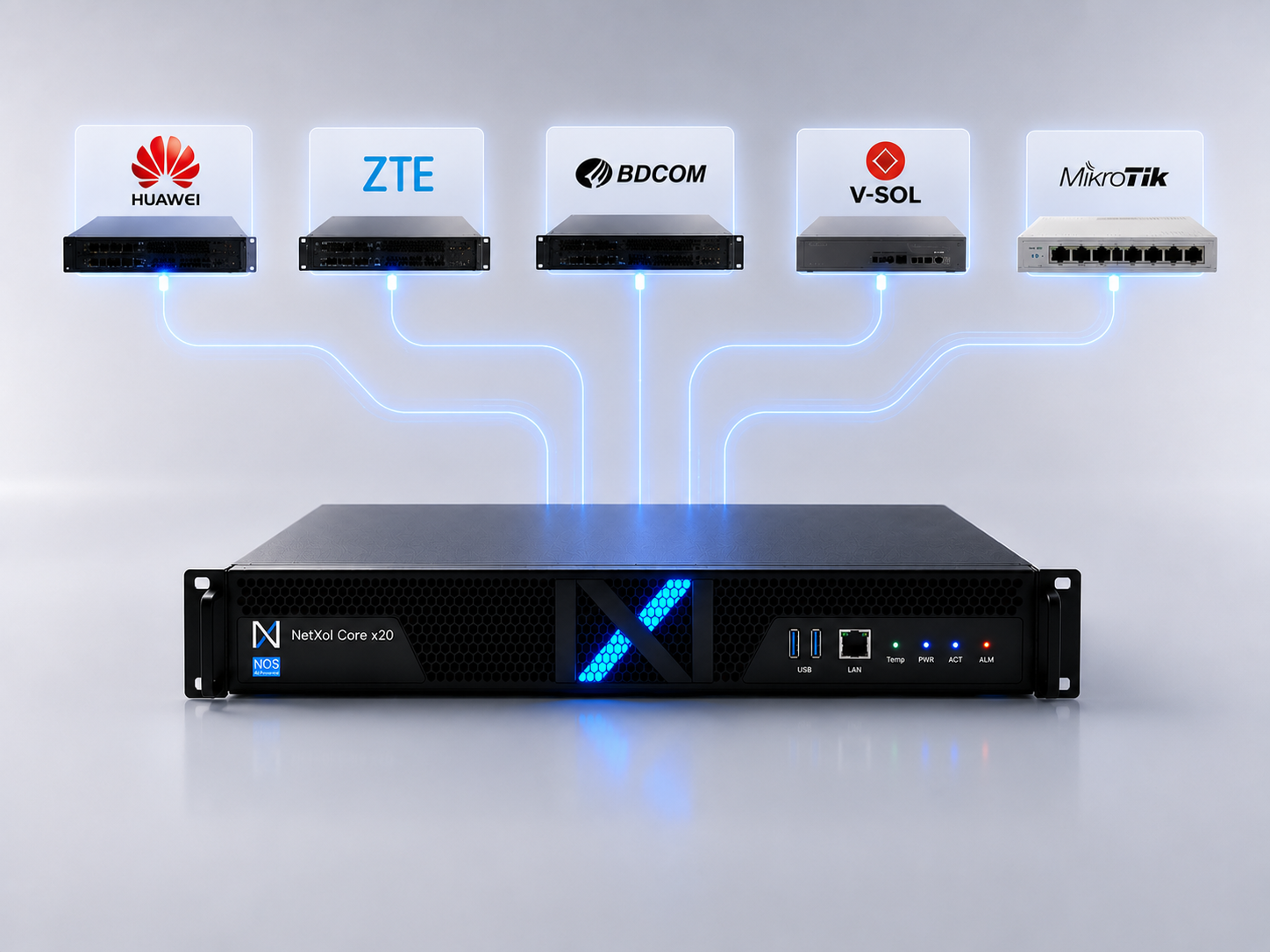
One platform across five hardware vendors
Netxol unified monitoring, OLT management and ACS across a mixed Huawei, ZTE, BDCOM, V-SOL and MikroTik estate — retiring four legacy tools, halving software OpEx, and producing a single operating model group-wide.
4
Tools retired
−34%
OpEx on software
5
Vendors unified
A European holding group had grown by acquiring three regional ISPs in five years. Each acquisition arrived with its own back-of-house: its own NMS, its own OLT controller, its own conventions, its own scripts. By the time the holding company decided to consolidate, engineers were context-switching across four dashboards on a normal day and the software stack had become the second-largest non-bandwidth line in the group P&L.
Background
Combined subscriber base: 220,000 across four operating territories. Combined OLT estate spans Huawei MA5800 / MA5683T, ZTE C300, BDCOM, V-SOL and a small Nokia ISAM footprint. Routers and aggregation switches are mostly MikroTik and Cisco. ACS deployments were two — one running TR-069 only, one running a vendor-locked combination. The CRM situation was similar: two production systems and one half-finished migration.
The board mandate was clear but the engineering reality was that no single team had visibility across all the territories at once, and "consolidation" had been on the roadmap for two cycles without progress. The challenge was as much organisational as technical: how to bring four operating cultures onto one platform without losing the institutional knowledge baked into the old tools.
Approach
5-month rollout, territory by territory
- Topology audit across all four territories — reconciled 1,840 device-level discrepancies.
- Mapped each legacy tool's scope to Netxol modules; identified 12 capability gaps to backfill before migration.
- Identified two scripts critical to operations that needed first-class platform support (a custom RADIUS sync and a billing reconciliation job).
- Stood up Netxol in the smallest, newest territory (18k subscribers, single OLT vendor).
- Validated all critical operating workflows: provisioning, fault management, billing, reporting.
- Engineers from that territory became internal champions for the rollout to the larger ones.
- Onboarded the two large territories simultaneously — each migration team paired with a champion from Phase 2.
- Data migration: 168k subscribers, 14k devices, 22 years of historical billing transactions.
- Reconciliation difference at cutover: 0.04% of records, all resolved within 72h.
- Decommissioned 4 legacy systems (2 NMSes, 1 ACS, 1 CRM).
- Reclaimed 14 VMs and approximately $86k / year in commercial licences.
- Final cleanup: deleted 312 ad-hoc scripts; the operations they performed are now first-class platform features.
The hardest part was vendor-neutral templates
The most demanding engineering work in this project was not the migration itself; it was the design of vendor-neutral service profiles. Each legacy NMS had encoded the operator's business policies inside vendor-specific configuration blocks. Re-expressing those policies as portable templates — that compile down to the right Huawei command, ZTE command, BDCOM command — was where the value lived. Done once, every future vendor onboards in days, not months.
Outcomes
| Metric | Before | After | Δ |
|---|---|---|---|
| NMS dashboards engineers use daily | 4 | 1 | −75% |
| Software stack OpEx / year | $252k | $166k | −34% |
| Cross-territory reporting time | 3 days analyst time | < 1 hour automated | −98% |
| New-vendor onboarding time | ~3 months | ~10 days | −89% |
The cultural change that came with it
A platform consolidation is also a knowledge consolidation. The Group CTO told us that the single most useful artefact from the project was not the cost saving but the unified operations runbook — a 60-page document that for the first time described how the group operated, not how each territory operated. The old tribal knowledge from each acquisition got documented, debated, and either kept (as a policy) or retired (as an artefact of an old way of working).
A surprising benefit
Engineering hiring became easier. Candidates being interviewed could see one platform with one set of tools — not "we use four different things and you will spend a year learning them all." Time-to-productivity for new hires fell from a stated 6 months to a measured 8 weeks.
Tech stack used
- Netxol NMM with adapters for Huawei MA5800, ZTE C300, BDCOM, V-SOL and Nokia ISAM.
- Netxol ACS (TR-069 + TR-369) consolidating two prior ACS deployments.
- Netxol portable service profiles — vendor-agnostic policy compiled to vendor-specific config.
- Group reporting & exec assistant module — replaces analyst-built monthly reports.
- Migration tooling: subscriber/billing/asset reconciliation, with auditable diff reports.
Lessons we carried forward
- Always start with the smallest territory. The political dividends are bigger than the technical ones.
- Time spent on portable service profiles in Phase 1 pays itself back twice during the migration and forever afterward.
- Reconciliation tolerance has to be agreed up-front. We chose 0.05% of records as the cutover bar.
- Decommissioning is its own project — do not let it slip. Old tools left running rot the saving.